
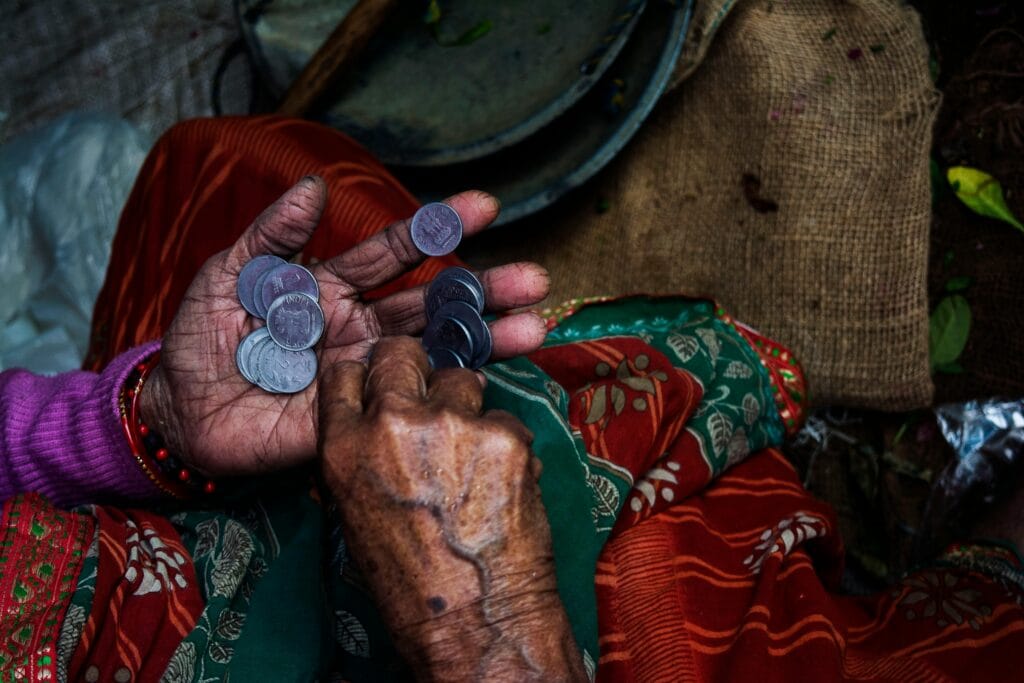
Poverty is a worldwide phenomenon with its many faces and dimensions; it varies from region to region. Generally, the poor in any society or any part of the world is one who suffers from poverty or very limited access to the basic needs of human existence. It is considered as the situation of not getting enough money to acquire desirable and necessary things. Every human being requires some minimum consumption level to live. These requirements contain the minimum needs in respect of food, clothing, housing, education and health. Poverty is the incapability to secure this minimum consumption level.
Poverty is a major problem facing most nations in the world. It has destroyed or adversely affected societies and families all over the world. It exists since the dawn of civilization and many ideologies have been invented to cope with this problem. But poverty refuses to die. It is felt that all efforts should be made to eradicate poverty. It is also believed that human life would remain unsatisfied unless poverty is fully removed.
The Sweedish Academy said, while conferring Nobel Prize on Prof. Muhammed yoonus, that “lasting Peace cannot be achieved unless large population groups find ways in which to break out of poverty”
Islam is an entire way of life, and Allah’s Guidance extends into all areas of our lives. It has given detailed regulations for our economic life, which is balanced and fair. Muslims are to recognize that wealth, earnings, and material goods are the property of God, and we are merely His trustees. The principles of Islam aim at establishing a just society wherein everyone will behave responsibly and honestly. It is forbidden to gain property or wealth by fraud, deceit, theft, or other falsehoods. “…Give just measure and weight, and do not withhold from people the things that are their due. And do not do mischief on the earth after it has been set in order. That will be best for you, if you have faith.” (7:85). Payment of Zakat (alms) is one of the basic pillar of Islam. Allah commands in the Quran, “And they have been commanded no more than this: to worship Allah, offering Him sincere devotion, being true in faith. To establish regular prayer, and to give zakat. And that is the religion right and straight.” (98:5) Every Muslim who owns wealth, more than a certain amount to meet his or her needs, must pay a fixed rate of Zakat to those in need. Zakat is a means of narrowing the gap between the rich and the poor, and to make sure that everyone’s needs are met.
Productivity can only increase if there is a circulation of wealth-an effective distribution of wealth-which the capitalist economic system fails to achieve. Consequently the philosophy that the market will naturally distribute wealth throughout society as a result of the relationship between production and price is erroneous from its basis and has never been achieved in reality. It has been required foreign intervention to alleviate poverty through increased aid; an occurrence which only exacerbates the debt problem. As a result the gulf between rich and poor countries has increased exponentionaly with disastrous consequences.
Islam prohibits the hoarding of wealth and this would be enforced by government. This would create the economic conditions in which entrepreneurial activity can flourish by empowering the people to become economically productive. So if the land has not been worked on for more than three years then people would lose ownership of that land, and transfer ownership to people who will use the land productivity.
Central to the problem of the development aid in the capitalist context is the interest-based system, which has crippled the developing world; Islam’s prohibition of interest prevents these types of scenarios developing. The multilateral debt burden of the poorest countries has grown exponantionally rising to 800%, which means that, on average African countries are paying $27 million a day in debt. The Islamic system prohibits interest according to the Quranic evidence:
“O you who believe! Fear Allah and give up what remains of your demand for usury if you are indeed believers. If you don’t, take notice of war from Allah and His messenger. But if you turn back, you shall have your capital sums. Deal not unjustly and you shall not deal with unjustly” (2:278-279)
Therefore in an Islamic economy loans would be free from interest, allowing African as well as developing Asian countries to spend more on developing infrastructure, health and education than on servicing debt. Only then could these countries bring themselves out of poverty by having the ability to develop its industries that can compete in the global market.
There needs to be a radical shift in thinking and any solution for world, and organization of the globe economy requires a comprehensive solution that addresses people’s values, criteria and objective in life .The Islamic ideology-in spite of human imperfections in its implementations –provide that alternative. Islam links our actions to higher values and greater ideas which address the core of the problem facing the world. The belief that the human mind can determine good and bad regardless of time and complexity, which is the base of capitalism is poverty to erroneous. If millions of people who have died from poverty are not sufficient proof then no proof will really suffice.